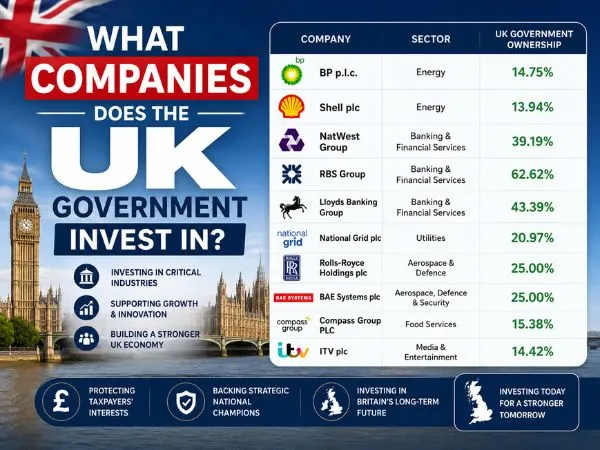
When we think of government spending, we usually picture roads, schools, and hospitals. But what you might not realize is that the UK government is actually one of the country’s most powerful corporate shareholders.
Through state-owned holding companies like UK Government Investments (UKGI) and strategic vehicles like the National Wealth Fund and the British Business Bank, the UK government owns entire companies, holds massive equity stakes in strategic assets, and acts as a venture capitalist for early-stage startups.
If you are wondering exactly which companies the UK government is investing in right now, here is a complete breakdown of the 2026 state-backed portfolio and why these investments matter.
The UKGI Portfolio: What Does the Government Own?
The central manager for the government’s corporate assets is UK Government Investments (UKGI), which acts as the shareholder for over two dozen commercial entities on behalf of HM Treasury. The goal isn’t necessarily to day-trade for profit, but rather to secure critical national infrastructure, support strategic industries, or manage legacy state-owned assets.
Here are the most notable companies the UK government holds a stake in today:
1. Nuclear Energy & Power
As the UK pushes toward energy independence and net-zero targets, the government has heavily backed nuclear power:
- Sizewell C (44.9% Equity): The government holds a near-majority stake in this massive new nuclear power station project in Suffolk, ensuring it gets built despite immense capital costs.
- Urenco Group (33.3% Equity): A highly profitable uranium enrichment company. The UK government owns a third, alongside the Dutch and German governments.
- National Energy System Operator (NESO): A newly established, fully publicly owned body responsible for planning Britain’s electricity and gas networks.
2. Space, Tech, and Defence
National security is a primary driver for recent government equity investments:
- Eutelsat OneWeb (10.9% Equity): When the satellite broadband company OneWeb went bankrupt in 2020, the UK government controversially bought a massive stake to secure sovereign satellite capabilities (later merging it with Eutelsat).
- Sheffield Forgemasters (100% Owned): The government fully nationalized this historic heavy engineering firm to secure the supply chain for the UK’s defense and nuclear submarine programs.
- Ordnance Survey (100% Owned): Far more than just paper maps, OS is a globally recognized geospatial data and technology company entirely owned by the state.
also read : – Is Elevenkicks Legit?: Get all the details about the store here!
3. Media, Retail, and Infrastructure
The government still retains total ownership of several iconic British institutions that operate commercially:
- Channel 4 (100% Owned): Despite years of privatization debates, the government confirmed in 2023 that the commercially funded broadcaster will remain publicly owned.
- The Post Office & The Royal Mint (100% Owned): Both operate as commercial businesses with the government acting as the sole shareholder.
- Network Rail & National Highways (100% Owned): The corporate entities responsible for managing the country’s rail infrastructure and motorways.
Explore the Government’s Portfolio
To see how the UK government balances its investments between wholly-owned entities and strategic minority stakes, you can explore the data below:
Key insight: While legacy institutions like Channel 4 and the Royal Mint are 100% state-owned, modern strategic investments (like OneWeb and Sizewell C) take the form of minority equity stakes, meaning the government acts more like a traditional venture capital or private equity partner.
The End of an Era: The Exit from Banking
For over a decade, the most famous stock the UK government owned was NatWest Group (formerly Royal Bank of Scotland).
During the 2008 financial crisis, the government bailed out the bank, taking an 84% ownership stake to prevent an economic collapse. Over the next 17 years, the Treasury slowly sold off its shares back into the private market.
In a massive milestone for the UK economy, the government finally sold its last remaining shares in NatWest in May 2025, officially closing the book on the 2008 bank bailout era.
The Government as a Venture Capitalist (British Business Bank)
Aside from massive infrastructure and legacy companies, the UK government is also deeply invested in the startup ecosystem.
Rather than buying shares directly on the stock market, the government uses the British Business Bank (BBB) and the National Security Strategic Investment Fund (NSSIF) to funnel billions of pounds into venture capital funds. These state-backed funds then take equity stakes in high-growth British startups focusing on:
- Artificial Intelligence and Quantum Computing.
- Life sciences and biotechnology.
- Advanced manufacturing and green tech.
While you won’t see the government’s name on a startup’s cap table, state money is directly fueling the next generation of UK tech unicorns.
Frequently Asked Questions (FAQ)
What is UK Government Investments (UKGI)?
UK Government Investments (UKGI) is a private limited company wholly owned by HM Treasury. It acts as the government’s center of excellence for corporate finance and corporate governance. UKGI does not invest public money on a whim; instead, it manages the government’s shareholder stakes in roughly 20+ major commercial entities, such as Channel 4, the Post Office, and Sizewell C, ensuring they are run efficiently on behalf of the British taxpayer.
Does the UK government still own shares in NatWest Bank?
No. After a 17-year exit strategy following the 2008 financial crisis bailout, the UK government officially sold its remaining shares in NatWest Group (formerly Royal Bank of Scotland) in May 2025. The bank has returned completely to private ownership.
How can a small business get investment from the UK government?
The UK government does not usually buy direct equity stakes in small businesses or early-stage startups. Instead, it invests through the British Business Bank, a state-owned development bank. The British Business Bank partners with private venture capital funds, angel networks, and regional funds to supply equity finance and startup loans to growing companies across the UK.
Why does the government own commercial companies like Channel 4 or the Royal Mint?
Most of these companies are state-owned because they serve a specific public function, protect critical national security, or manage public infrastructure. For example, Channel 4 operates under a public service broadcasting mandate, the Royal Mint provides sovereign coinage security, and Sheffield Forgemasters was acquired entirely to secure the heavy steel supply chain needed for Britain’s defense programs.
Does the UK government have a Sovereign Wealth Fund?
Yes. The UK government transitioned its existing infrastructure investment structures into the National Wealth Fund (NWF). The NWF is designed to co-invest alongside private institutional investors, deploying public capital into clean energy, gigafactories, carbon capture, and green steel infrastructure to catalyze private investment in the UK.