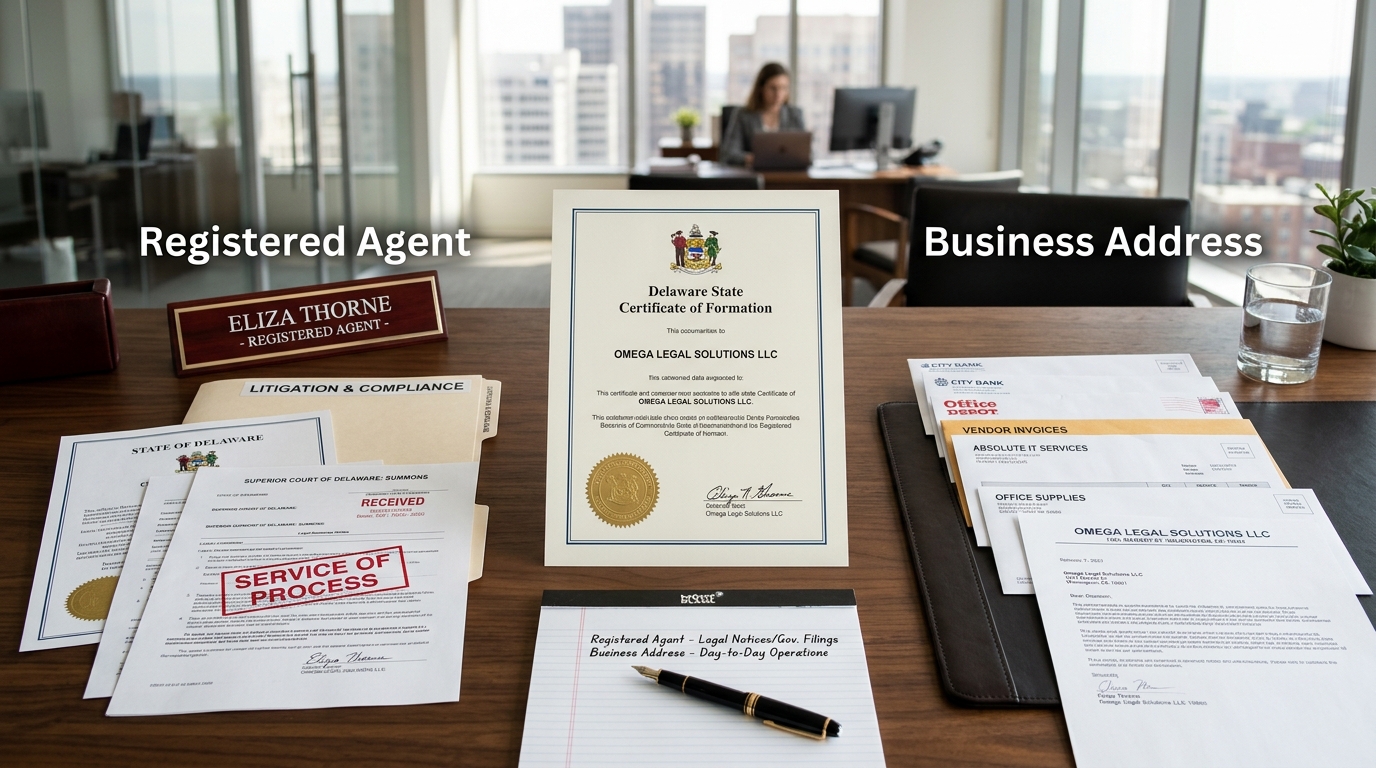
The fundamental difference between a registered agent and a business address is their legal function: a registered agent is a statutory entity designated to accept legal summons (Service of Process) and state government compliance notices, while a business address is the physical or virtual location where your company conducts day-to-day commercial operations. Under state corporate law across all 50 US jurisdictions, every LLC and corporation must maintain a registered agent with a physical street address open during regular business hours within the state of incorporation. Conversely, a business address handles customer correspondence, vendor billing, marketing collateral, and merchant banking.
While an entrepreneur can legally list their primary business address as their registered office, doing so exposes personal home addresses to public state databases, invites process servers into customer-facing areas, and risks catastrophic default judgments if legal notices are missed. Below is the complete legal and operational breakdown comparing registered agents, principal business addresses, virtual mailboxes, and PO box compliance rules.
Quick Summary Verdict
- Registered Agent: Mandatory by State Law. Receives official lawsuits, subpoenas, tax liens, and annual report notifications. PO Boxes are strictly prohibited.
- Business Address: Operational & Commercial. Where you interact with customers, banks, and suppliers. Can be a commercial building, home office, or virtual office.
- Privacy Shield: Using a professional commercial registered agent service keeps your personal residence off the searchable Secretary of State public registry.
What Is a Registered Agent?
A registered agent—also designated as a statutory agent, resident agent, or agent for service of process—is an individual or commercial entity officially registered with the state to receive legal and government correspondence on behalf of a company.
State corporate statutes mandate that every formal business entity maintain an active registered agent to guarantee due process. The core responsibilities of a registered agent include:
- Service of Process: Accepting court summons, complaints, subpoenas, and garnishment orders when a lawsuit is filed against the business.
- State Tax & Franchise Notices: Receiving formal annual report filing deadlines, tax compliance warnings, and forfeiture notices from the Department of Revenue or Secretary of State.
- Statutory Availability: Maintaining continuous physical presence during standard 9:00 AM to 5:00 PM business hours at a verified street address (known as the registered office) in the state of formation.
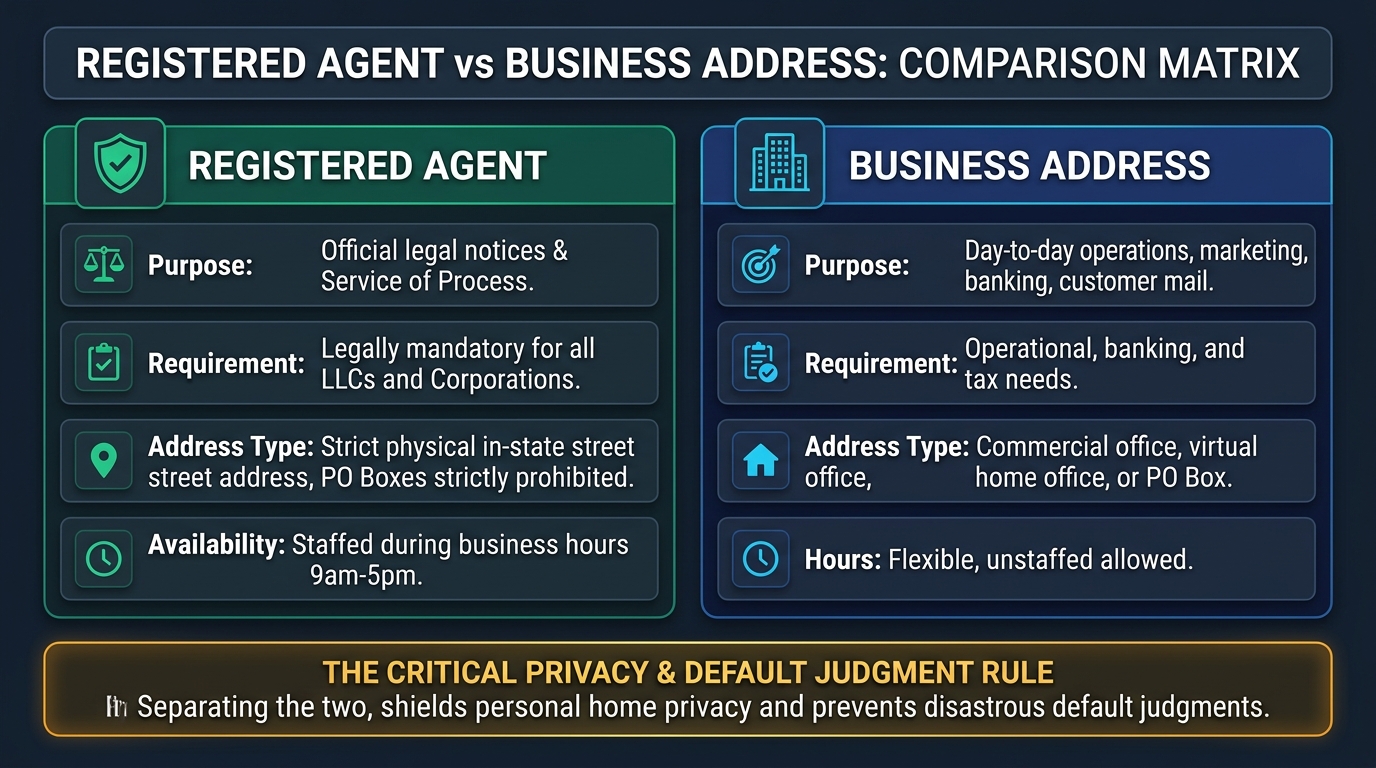
Figure 1: Core operational and statutory differences between a Registered Agent and a Principal Business Address.
What Is a Business Address?
A business address—formally identified on entity filings as the “Principal Place of Business” or “Principal Office Address”—is the central hub where executive management operates and commercial activities transpire.
Unlike a registered agent, which exists exclusively for statutory compliance, your business address serves functional, outward-facing commercial purposes:
- Merchant & Commercial Banking: Satisfying FinCEN Customer Due Diligence (CDD) and federal Know Your Customer (KYC) requirements when opening commercial checking accounts and credit lines.
- Vendor & Customer Billing: Receiving operational invoices, inventory shipments, client contracts, and standard marketing mail.
- Tax Filings (IRS Form SS-4): Identifying your corporate headquarters on federal tax returns and local municipal business license applications.
- Brand & Web Presence: Publishing on website footers, Google Business Profiles, email newsletters (CAN-SPAM Act compliance), and public directory listings.
Direct Side-by-Side Comparison Matrix
Understanding where these legal roles diverge across corporate requirements prevents operational errors:
| Feature / Requirement | Registered Agent (Office) | Principal Business Address |
|---|---|---|
| Primary Purpose | Official lawsuits, court subpoenas & state notices | Day-to-day operations, banking & customer mail |
| Is it Legally Mandatory? | Yes (Mandatory across all 50 states) | Yes (For operational, banking & tax purposes) |
| Can You Use a P.O. Box? | STRICTLY ILLEGAL (Must be physical address) | Sometimes for general mail (Not for banks) |
| Must it Be In-State? | Yes (Must reside in state of formation/registration) | No (Can be located in any state or country) |
| Hours of Availability | Strictly 9:00 AM – 5:00 PM standard business days | Flexible (Based on operating hours) |
| Public Visibility | Publicly searchable on Secretary of State database | Publicly visible on websites, invoices & Google |
Can Your Registered Agent Address and Business Address Be the Same?
Yes, state law allows your registered agent address and your business address to be identical, provided the location is a physical street address within your state of formation that remains staffed during business hours.
Many solo entrepreneurs and early-stage startup founders designate their home or physical office as both. However, this common setup introduces three significant legal and operational risks:
- Erosion of Personal Privacy: Because registered agent filings are public record, your residential address becomes permanently indexed on public state databases, corporate search portals, and data-scraping sites, exposing you to junk mail, solicitations, and unexpected visitors.
- Public Embarrassment via Service of Process: If your company is named in a lawsuit or dispute, a uniformed sheriff or private process server will physically hand-deliver court documents. Having a lawsuit served in front of clients, staff, or family members is highly disruptive.
- The Default Judgment Catastrophe: If you are away on travel, sick, or working remotely and miss a time-sensitive court summons, the court can enter a default judgment against your business. This legally forfeits your defense and allows the plaintiff to garnish bank accounts or seize assets automatically.
How Virtual Offices and Commercial Services Bridge the Gap
To preserve maximum privacy, corporate credibility, and regulatory compliance, sophisticated businesses separate these functions into dedicated channels:
- Commercial Registered Agent Service: For $100 to $300 annually, professional registered agent providers (such as Northwest Registered Agent, CT Corporation, or Incfile) act as your legal buffer, scanning legal notices into an encrypted dashboard within hours of delivery.
- Virtual Office / Commercial Mailbox: Provides a prestigious commercial street address in major metropolitan centers for client billing, Google Maps verification, and banking compliance without paying commercial lease overhead.
For small business owners structuring their legal and financial foundations, reviewing our operational guide on calculating small business working capital and our strategic playbook on resolving commercial cash flow traps provides essential enterprise liquidity depth.
Frequently Asked Questions (FAQ)
-
Can I use a P.O. Box as my registered agent address?
No, state law strictly prohibits using a P.O. Box as a registered agent address. The registered office must be a physical street address where a process server or state official can physically hand-deliver legal documents to a live representative during regular business hours.
-
Can I be my own registered agent?
Yes, you can act as your own registered agent if you are at least 18 years old and reside in the state of formation. However, your physical address will become public record on the Secretary of State’s website, and you must remain physically present at that address during business hours to accept legal documents.
-
Can a registered agent address be located in another state?
No, a registered agent must be physically located within the state where your entity is registered. If your LLC is formed in Delaware or registered as a foreign entity in California, you must maintain a physical registered office within that specific state’s borders.
-
Will my registered agent receive everyday customer mail and bills?
No, registered agents are designated strictly for legal notices, court summons, and official government correspondence. Most commercial registered agent services will discard or return standard customer mail, junk mail, and commercial packages that do not originate from state agencies or courts.