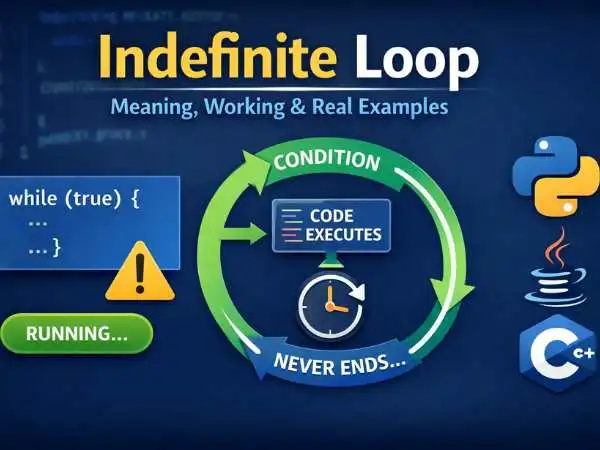
An indefinite loop is one of those programming ideas that looks simple on the surface but causes real trouble when misunderstood. Many beginners meet it by accident. A program freezes. CPU usage spikes. Nothing responds. And the question comes up fast: What just happened?
In most cases, the answer is an infinite loop.
This blog explains indefinite loops in a clean, practical way. You’ll learn what a loop is in programming, what an indefinite loop means, how infinite loops work, why developers use them on purpose, and how they appear in real languages like JavaScript, Golang, and SAP ABAP. You’ll also see clear infinite loop examples and ways to avoid mistakes.
What Is a Loop in Programming?
Before talking about indefinite loops, it helps to step back.
A loop in programming is a control structure that allows code to run repeatedly. Instead of writing the same logic many times, a loop repeats it until a condition is met.
Loops exist to:
- reduce code duplication
- automate repetitive tasks
- process collections of data
- wait for events
Almost every program relies on loops in some form.
also read : – How IVR Supports Remote and Hybrid Teams in 2025
Common Types of Loops
Most programming languages support a few standard loop types.
- for loop
- while loop
- do-while loop
- foreach loop
Each loop type has rules about when it starts, when it stops, and how conditions are checked.
What Is an Indefinite Loop?
An indefinite loop is a loop that does not have a fixed number of iterations. Instead of running a known count of times, it runs until a condition changes.
The key idea is uncertainty.
You don’t know in advance how many times the loop will execute. It depends on:
- user input
- external events
- data changes
- system state
Not all indefinite loops are infinite. Some end naturally when conditions are met.
Indefinite Loop vs Infinite Loop
These two terms often get mixed up.
An indefinite loop:
- has no fixed iteration count
- may end eventually
- depends on conditions
An infinite loop:
- never ends on its own
- condition always stays true
- must be stopped externally
Every infinite loop is indefinite.
Not every indefinite loop is infinite.
also read : – 4 Tricks to Move WhatsApp Messages from iPhone to Android
What Is an Infinite Loop?
An infinite loop is a loop that runs forever because its stopping condition is never satisfied.
Once entered, the loop keeps executing unless:
- the program crashes
- the process is killed
- a break condition is added
Infinite loops can be accidental or intentional.
How Do Infinite Loops Work?
To understand how do infinite loops work, focus on the loop condition.
A loop becomes infinite when:
- the condition is always true
- the condition never changes
- the exit logic is unreachable
This often happens due to logic errors.
Simple Infinite Loop Example
Consider this logic:
while (true) {
doSomething();
}
The condition true never changes. The loop never exits.
This is a deliberate infinite loop.
Accidental Infinite Loop Example
Accidental infinite loops are more common.
Example logic:
- variable starts at 0
- condition checks if variable < 10
- variable is never updated
The condition stays true forever.
Why Infinite Loops Are Sometimes Useful
Infinite loops aren’t always mistakes. Many systems rely on them.
Common use cases include:
- servers waiting for requests
- event listeners
- game loops
- embedded systems
- operating system schedulers
In these cases, the loop runs continuously and reacts to events.
Indefinite Loop in Real Programs
An indefinite loop often looks like this:
- program waits for input
- loop checks for a signal
- loop exits when signal arrives
The number of iterations is unknown, but termination is possible.
also read : – Best apps to hide apps
Infinite Loop in JavaScript
The infinite loop in JS can be especially dangerous because it may block the browser or Node.js event loop.
Example: Infinite Loop in JavaScript
while (true) {
console.log(“Running…”);
}
In a browser, this can freeze the page. In Node.js, it can block async tasks.
JavaScript Infinite Loop with for
for (;;) {
// no condition
}
This is valid JavaScript and runs forever.
Avoiding Infinite Loops in JavaScript
Best practices include:
- using clear exit conditions
- avoiding heavy logic in loops
- adding safeguards like counters
- testing with small data sets
Infinite Loop in Golang
The infinite loop in golang is often written intentionally using for.
Golang Infinite Loop Example
for {
// loop forever
}
This pattern is common in:
- servers
- goroutines
- background workers
Exit usually happens through:
- break
- return
- channel signals
Controlled Infinite Loops in Golang
Golang developers often pair infinite loops with select statements to wait for events safely.
Infinite Loop in SAP ABAP
The infinite loop in SAP ABAP can occur in DO or WHILE loops.
Example: ABAP Infinite Loop
DO.
WRITE: ‘Hello’.
ENDDO.
Without an exit condition, the loop never stops.
Preventing Infinite Loops in ABAP
ABAP developers typically:
- include EXIT conditions
- track counters
- validate loop logic carefully
In enterprise systems, infinite loops can affect system performance severely.
also read : – What is Imginn And How To Use It?- Know in Detail
Infinite Loop Examples Across Languages
Here are general infinite loop examples that appear in many languages.
While Loop Example
while (condition) {
// condition never changes
}
For Loop Example
for (i = 0; i >= 0; i++) {
// i always increases
}
Do-While Loop Example
do {
// logic
} while (true);
Common Causes of Infinite Loops
Most infinite loops come from simple mistakes.
Common causes include:
- missing variable updates
- incorrect comparison operators
- floating-point precision errors
- logic paths that skip exit conditions
- copy-paste errors
Infinite Loops and Performance Problems
Infinite loops can:
- consume CPU endlessly
- increase memory usage
- block threads
- freeze applications
In production systems, this can lead to outages.
Debugging an Infinite Loop
When a program hangs, infinite loops are often suspects.
Debugging steps include:
- checking loop conditions
- adding logs
- stepping through code
- using breakpoints
- monitoring CPU usage
Finding the condition that never changes is the key.
Safe Design for Indefinite Loops
Indefinite loops can be safe if designed properly.
Good practices include:
- clear exit conditions
- timeouts
- max iteration limits
- external signals
- error handling
These turn risky loops into controlled ones.
also read : – Slayer Leecher : How can you use slayer Leecher?
Indefinite Loop in Event-Driven Systems
Event-driven systems rely heavily on indefinite loops.
The loop:
- waits for events
- processes them
- goes back to waiting
This design supports responsiveness without constant polling.
Indefinite Loop vs Recursion
Some tasks use recursion instead of loops.
Differences:
- loops reuse stack frames
- recursion consumes stack space
- infinite recursion causes stack overflow
Infinite loops don’t overflow the stack but still consume resources.
When to Avoid Infinite Loops
Infinite loops should be avoided when:
- running in UI threads
- handling untrusted input
- processing user-facing logic
Use bounded loops instead.
Teaching Indefinite Loops to Beginners
Beginners often struggle with loop termination.
Teaching tips:
- trace loop variables manually
- visualize condition changes
- start with small examples
- test exit paths
Understanding conditions builds confidence.
Indefinite Loops in Competitive Programming
Competitive programming problems often use indefinite loops to:
- read input until EOF
- process unknown input sizes
Clear termination checks are critical.
Indefinite Loop in System Programming
System-level programs rely on indefinite loops for:
- scheduling
- monitoring
- signal handling
These loops form the backbone of long-running services.
Infinite Loops and Multithreading
In multithreaded systems:
- infinite loops can starve other threads
- synchronization issues may hide exit conditions
Proper locking and signaling matter.
How to Break an Infinite Loop Safely
Breaking out requires:
- break statements
- return statements
- external signals
- interrupts
Never rely on force-stopping unless necessary.
also read : – What Is Broward SSO, & How does it works ?
Real-World Example: Server Loop
A typical server loop:
- waits for connections
- handles requests
- continues running
It’s infinite by design but controlled by events.
Indefinite Loop Testing Strategies
Testing indefinite loops requires:
- mock conditions
- time-based exits
- controlled inputs
Tests should never hang indefinitely.
Why Understanding Indefinite Loops Matters
Indefinite loops appear everywhere:
- system software
- web servers
- embedded devices
- business applications
Understanding them prevents bugs and improves design decisions.
Final Thoughts on Indefinite Loops
An indefinite loop is not a problem by itself. It becomes a problem when exit logic is missing or misunderstood. Infinite loops can be powerful tools or serious bugs, depending on intent and design.
Good programmers don’t avoid loops. They control them.
Learning how loops behave across languages like JavaScript, Golang, and SAP ABAP builds confidence and prevents costly mistakes.
also read : – Unveiling the Art and Science of Subject Line Mastery in Email Marketing
FAQs: Indefinite Loop
What is an indefinite loop
A loop that runs an unknown number of times until a condition changes.
What is an infinite loop
A loop that never ends unless stopped externally.
How do infinite loops work
They occur when loop conditions never become false.
Is an infinite loop always bad
No. Many systems use them intentionally.
How to avoid infinite loops
Use clear exit conditions, counters, and timeouts.
Where are infinite loops used
Servers, games, operating systems, and embedded systems.