
Invoice factoring without notifying customers—legally structured as confidential invoice discounting or non-notification factoring—allows businesses to monetize unpaid receivables without sending a Notice of Assignment (NOA) to their clients. In traditional factoring arrangements, the factor contacts your customers directly to demand payments, creating unwarranted fears regarding your firm’s solvency. Non-notification factoring eliminates this reputational risk by routing collections invisibly through a dedicated shadow trust account opened in your company’s name.
For growing enterprises managing long Net 60 or Net 90 payment terms with corporate clients, trapped working capital restricts payroll expansion and new inventory procurement. When businesses experience severe collection delays, understanding root liquidity friction is critical, as detailed in our analysis of cash flow problems in small businesses. Preserving positive client relationships while maintaining strong liquidity reserves represents the ultimate competitive advantage, directly strengthening your baseline balance sheet metrics outlined in our guide on how to calculate working capital for a small business.
The Non-Notification Advance Equation
Immediate Cash = Gross Invoice Value × Advance Rate (80% to 90%)
Final Distribution = Remaining Reserve (10% to 20%) − Factoring Discount Fee (1% to 3.5%)
Where collection efforts remain 100% internal, and the customer remits directly to an unbranded trust account without third-party intervention.
How Confidential Non-Notification Factoring Works (5-Step Mechanism)
Maintaining complete client invisibility requires a sophisticated financial lockbox architecture. The non-notification factoring lifecycle operates across five seamless stages:
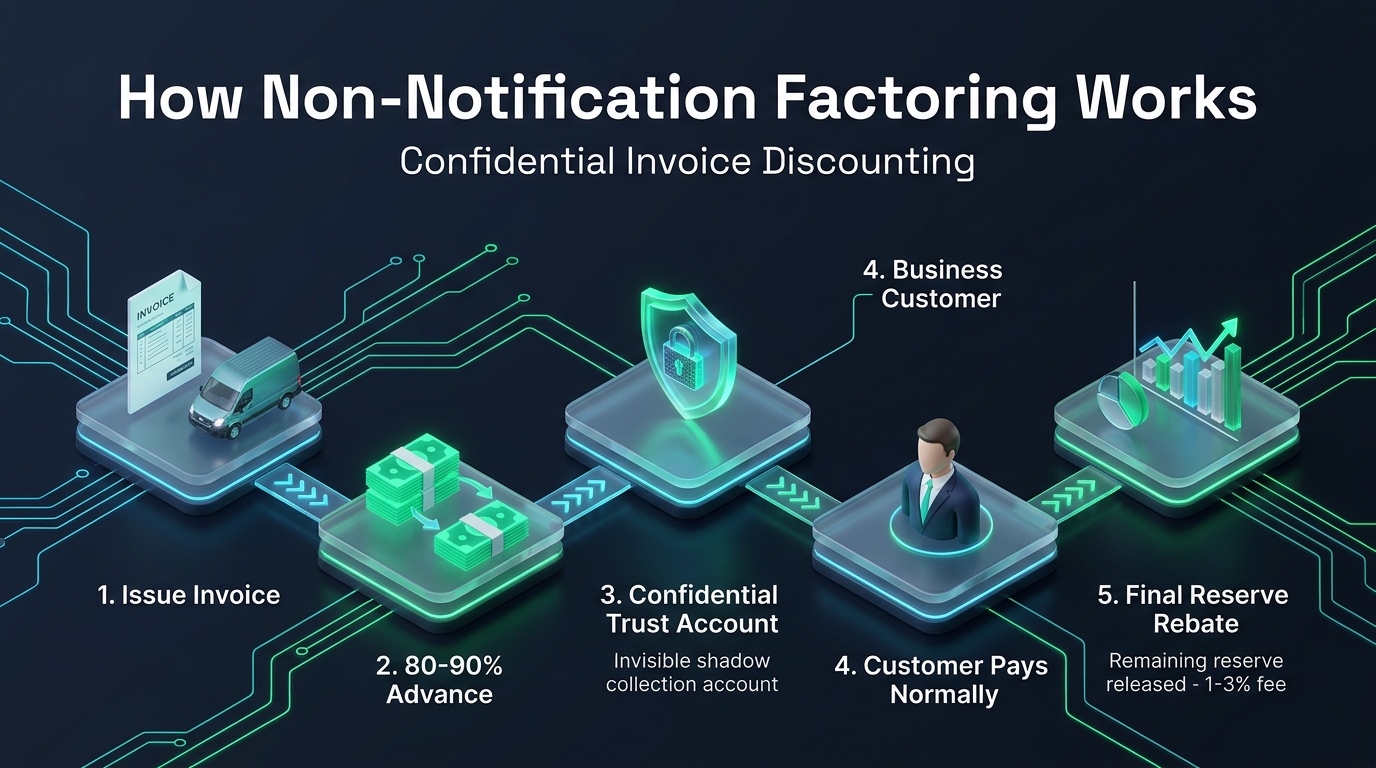
1. Standard Invoicing and Commercial Delivery
Deliver contracted goods or services and transmit standard branded invoices directly to your clients. The invoice features your standard corporate logo, commercial terms, and identical remittance details. No legal assignment disclosures, stampings, or third-party collection notices appear on the document.
2. Instant Liquidity Advance (80% to 90%)
Upload verified invoice copies and proof of delivery into your factoring partner’s secure digital portal. Upon rapid ledger verification, the factor transfers 80% to 90% of the gross face value into your primary operating checking account within 24 hours. You immediately deploy this working capital into payroll, inventory buys, or vendor disbursements.
3. Shadow Trust Account (Ghost Lockbox) Setup
Establish a dedicated blind trust account or electronic lockbox registered in your company’s legal entity name. While the bank account legally bears your business identity, the factoring partner maintains read and sweep authority behind the scenes. Your customers remit wire transfers, ACH deposits, or physical checks to this account believing it is your standard corporate bank.
4. Internal Credit Control and Collection Management
Your internal accounts receivable team continues managing all client communications, statements, and payment reminders. The factoring institution remains completely silent and never contacts your accounts payable counterparts. Your buyers experience seamless continuity with the exact same customer service contacts they have always trusted.
5. Reserve Settlement and Fee Deduction
When your client settles the outstanding balance into the trust account, the factor captures the principal and releases the reserve. The factor sweeps the cleared deposit, calculates their contractual discounting fee (typically 1.0% to 3.0% per 30-day period), and immediately wires the remaining 10% to 20% reserve balance back to your operational account.
Notification Factoring vs. Non-Notification Factoring
| Structural Feature | Non-Notification (Confidential) Factoring | Traditional Notification Factoring |
|---|---|---|
| Customer Visibility | 100% Invisible; clients never know | Explicit Notice of Assignment (NOA) sent |
| Payment Routing | Dedicated trust account in your business name | Direct payment to factoring company’s bank |
| Credit Control & Collections | Managed internally by your own staff | Managed by factor’s third-party collectors |
| Qualification Criteria | Strict: \$500k+ revenue, profitable, clean books | Flexible: Open to early startups and distressed firms |
| Factoring Fee Range | 1.0% to 2.5% per month (lower risk tier) | 2.0% to 4.5% per month (higher admin tier) |
| Underwriting Focus | Both your financial stability & client credit | Primarily your customers’ creditworthiness |
Underwriting and Qualification Criteria for Confidential Factoring
Because factoring institutions cannot communicate directly with your clients, they assume higher underwriting exposure. To mitigate perceived fraud and diversion risks, factors enforce strict qualification gates for non-notification credit lines:
- Minimum Annual Revenue: Most commercial factors mandate an established annual billing volume of at least \$500,000 to \$1,000,000 in creditworthy B2B receivables.
- Operating History and Profitability: A verifiable operating history of 12 to 24 months with clean, reconciled profit-and-loss statements and balance sheets.
- Sophisticated Internal Credit Controls: Established internal accounts receivable processes, low historical bad-debt write-offs, and disciplined Days Sales Outstanding (DSO) tracking.
- Clean Tax Compliance: Freedom from active federal tax liens or unrecorded UCC financing statements that impair collateral seniority.
Recourse vs. Non-Recourse in Confidential Facilities
Confidential invoice discounting facilities almost universally operate on a recourse basis. In a recourse structure, your business retains final liability if an enterprise customer defaults or fails to pay due to commercial disputes or insolvency within 90 days. If an invoice remains uncollected after the contracted eligibility window, your company must repurchase the unpaid claim or substitute it with an active, creditworthy invoice.
Non-recourse arrangements exist primarily in notification factoring, where the factor prices in the credit insurance risk and manages collections directly. In confidential factoring, credit insurance can occasionally be layered on top of the facility as an independent policy to protect against total debtor bankruptcy.
Strategic Implementation Checklist
Piyush Dwivedi’s Confidential Factoring Setup Checklist
- Step 1: Audit Commercial Contracts: Review client MSAs to confirm contracts do not contain strict assignment prohibitions or negative pledge covenants.
- Step 2: Clean Up Accounts Receivable Aging: Purge disputed billings and concentrate only on undisputed, delivered milestone receivables.
- Step 3: Setup Dedicated Shadow Account: Work with your chosen commercial lender to register a specialized trust lockbox matching your business name.
- Step 4: Align Accounting Software: Configure cloud accounting feeds (QuickBooks or Xero) to reconcile trust account sweeps automatically against open invoices.
- Step 5: Maintain Disciplined Follow-Ups: Enforce regular customer billing reminders so invoices clear within contractual 30-to-60-day terms.
Is it legal to factor invoices without notifying customers?
Yes, confidential invoice factoring is completely legal and widely utilized across commercial finance under the Uniform Commercial Code (UCC). A legally compliant trust account is established in your business name to collect payments invisibly.
How do customers pay in non-notification invoice factoring?
Customers pay into a designated shadow bank account or lockbox established in your company’s name. Although your factoring partner monitors and sweeps the funds, the account details reflect your corporate identity, keeping the lender invisible.
What are the eligibility requirements for confidential factoring?
To qualify for non-notification factoring, businesses typically need at least $500,000 in annual B2B revenue, an operating history of 1-2 years, strong internal credit control procedures, and creditworthy corporate clients.
How much does confidential invoice factoring cost?
Confidential invoice discounting typically costs between 1.0% and 2.5% per 30-day period. Because the factoring firm does not expend overhead on customer collections, rates are frequently lower than traditional notification factoring.
What happens if a customer does not pay in confidential factoring?
Confidential factoring facilities are typically recourse arrangements. If a client fails to pay after 90 days, your business must either repay the advanced funds or replace the delinquent receivable with a fresh, eligible invoice.
-
Is it legal to factor invoices without notifying customers?
Yes, confidential invoice factoring is completely legal under commercial banking law. Establishing an unbranded shadow trust account allows lenders to advance liquidity against receivables without notifying debtors.
-
How do customers pay in non-notification invoice factoring?
Customers remit payments into a dedicated shadow account opened under your corporate name. The factoring partner sweeps the cleared funds automatically while the debtor experiences an identical payment process.
-
What are the eligibility requirements for confidential factoring?
Lenders require \$500,000+ annual B2B revenue, 12 to 24 months of trading history, and strong internal billing systems. Because the factor remains invisible, they rely on your internal credit control rigor.
-
How much does confidential invoice factoring cost?
Discounting fees range between 1.0% and 2.5% per 30-day period on advanced balances. Rates remain competitive because the borrower handles daily administrative collections internally.
-
What happens if a customer does not pay in confidential factoring?
Most confidential agreements operate on recourse terms, meaning your company repurchases debts uncollected past 90 days. You can substitute the non-performing claim with a performing client invoice to preserve facility limits.